
Learning Center
The Learning Center is your hub for understanding how A.A. works, both in recovery and in service.
Here you’ll find resources that explain things like “what’s the upside-down triangle” or what’s a concept?” Whether you’re new to service or just curious about A.A.’s structure, this is the place to learn how we stay united and self-supporting.
All information has been adapted from the following source. Click below to read more:
STRUCTURE OF THE CONFERENCE (U.S. & CANADA)
“The Upside Down Triangle”
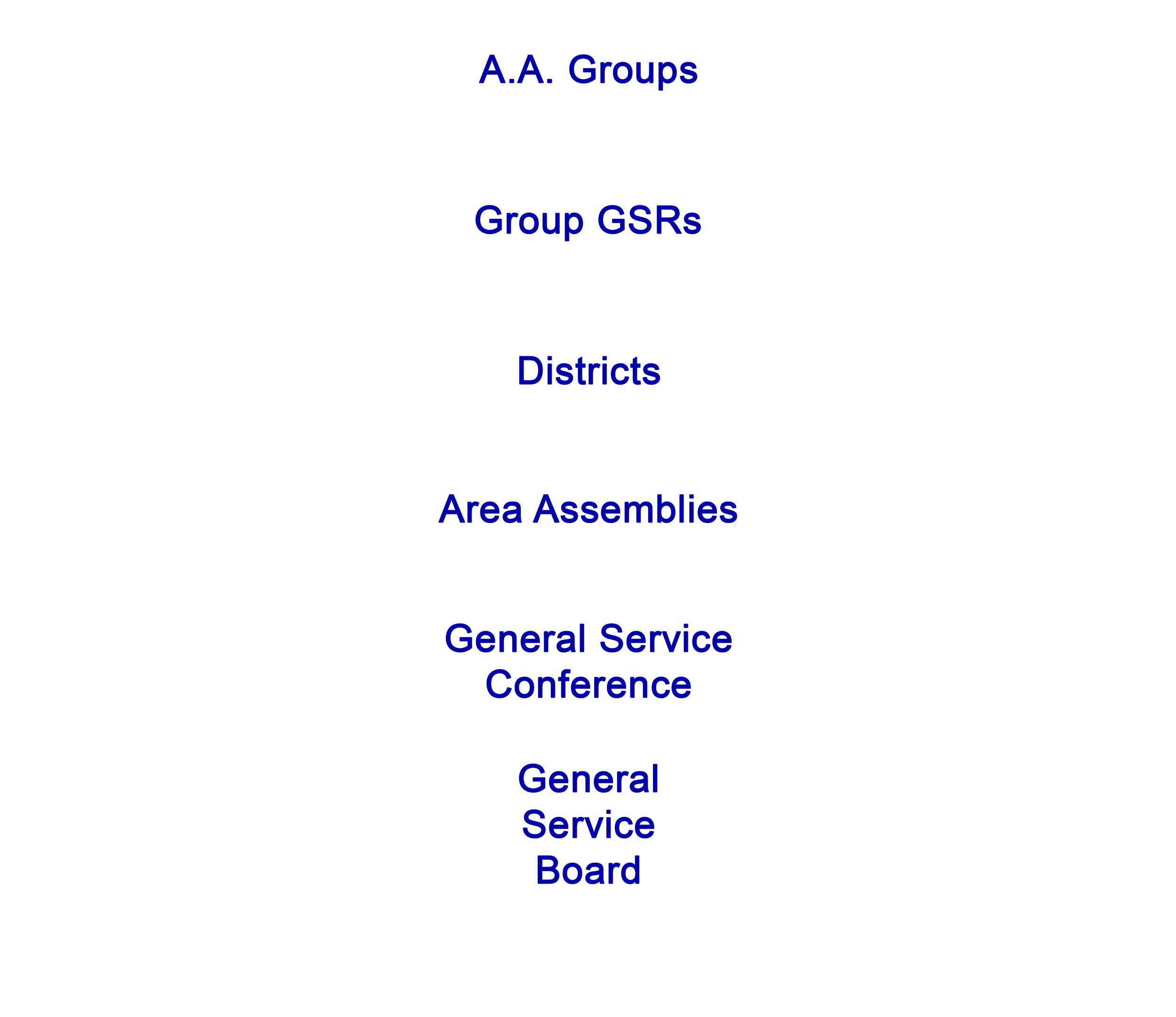
The upside-down triangle is divided into six sections; each represents a trusted servant tasked with helping to make the conscience of the groups known. Known to whom? Known to the entities that occupy the rest of the triangle that are charged with managing the affairs of “A.A. as a whole.”
It might be helpful to think of general service as a kind of dialogue or communication between the groups, the trusted servants working on their behalf, and the General Service Office and General Service Board as they all manage the Fellowship’s affairs. Questions, concerns, viewpoints and proposals travel from the groups “down the triangle”—and information and proposals head back “up the triangle” to the groups. And the communication continues.
How this works is illustrated below:

THE GROUP
The group meets to form a group conscience on proposed changes or actions on matters relating to A.A. as a whole. The group’s elected general service representative, or GSR, is tasked with: 1) making sure the group’s conscience is heard and fully considered at the district and the area and 2) becoming part of the delegate’s thinking at the Conference.

THE DISTRICT
Groups are organized into districts, generally collections of groups located near one another. The GSRs in each district elect the District Committee Member (DCM), who becomes part of the area committee.

THE AREA
The area holds periodic assemblies that include GSRs and DCMs as voting members. Assembly schedules and agendas are based on local autonomy and group conscience. Information about them can often be obtained from DCMs or other area trusted servants. The area handles a wide range of concerns, and one of the most important functions is electing the delegate to represent the area at the annual General Service Conference.

THE DELEGATE & THE CONFERENCE
Area delegates make up at least two-thirds of the Conference body. Other members making up the General Service Conference are trustees, both nonalcoholic (Class A) and alcoholic (Class B); directors of A.A. World Services and Grapevine; and A.A. staff at GSO, Grapevine and La Viña, bringing the total number of Conference members to approximately 135.
At the annual Conference, matters of importance to A.A. as a whole are considered and discussed. Items approved by a two-thirds majority of Conference members become Conference Advisory Actions; they are referred to the trustees of the General Service Board for disposition.
After the Conference meeting: Each delegate reports back to their area on Conference proceedings and the approved Conference Advisory Actions and additional committee considerations. Each GSR, having had the opportunity to hear from and ask questions of their delegate, is responsible for informing their group on the Conference outcome.

THE TRUSTEES
Trustees of the General Service Board, both nonalcoholic (Class A, “Amateurs”) and alcoholic (Class B, “Boozers”), have custodial oversight of A.A.’s two operating corporations:
AAWS, Inc., which employs GSO personnel, directs GSO services, and is responsible for A.A.’s website (aa.org) and broad publishing efforts.
AA Grapevine, Inc., which employs editorial and business personnel and publishes A.A.’s magazines, Grapevine and La Viña, and other related items across its digital platforms (aagrapevine.org and aalavina.org).
After the Conference meeting, the trustees review the Conference Advisory Actions and refer them to the appropriate trustees’ committees, GSO or AA Grapevine for implementation. The trustees report back through their quarterly reports on what steps they have taken.
A.A.’s Guiding Principles
-
THE STEPS
The spiritual foundation of Alcoholics Anonymous, as outlined in the book Alcoholics Anonymous, which offers a path to personal recovery.
-
THE TRADITIONS
Guidelines for relationships between the groups, members, the global Fellowship, and society at large, answering questions of finance, public relations, purpose, and more.
-
THE CONCEPTS
An interpretation of A.A.’s world service structure as it emerged through A.A.’s early history and experience, as written by A.A.’s co-founder Bill W..
More Questions?
Visit the FAQs page for answers some of the most common questions about A.A. in Manhattan and how General Service works. Whether you’re a newcomer looking for a meeting, a group trying to get connected, or a trusted servant learning about service, you’ll find clear explanations and helpful links here.